Neurotic Literature

*clears throat, taps microphone*

Erm… hello?

I don’t know if anybody is still out there reading this blog but if you’re there… hello!

Funny to think that there was once a time when posting opinions on the internet still felt a little bit niche, a little bit special. Back in the early pioneering days of blogging, we were special. Or at least, we felt like we were (and isn’t that all that matters?). Nowadays, everyone’s at it. Let’s not forget that before Elon ruined twitter, twitter ruined everything else.

Blogging in 2023 feels almost old fashioned. Who has time to read anything lasting more than a couple of sentences, for crying out loud?! And for that matter, who has the time to write anything of length. Nobody whose opinion is worth reading, I’ll warrant.

This blog had its roots in writing about our creative endeavours, about Doctor Who, and about politics. Well, to tackle those things in reverse: back in the day, when politics was still an enjoyable enough topic to make for a decent musical theatre spectacle, I used to get quite a kick out of immersing myself in whatever was being discussed on The Today Programme. But these days, for reasons I needn’t spell out, immersing myself in anything political for any length of time makes me feel like I need an instant shower. Besides which, it’s hard to see the value of adding my voice to the millions shouting into the void (even though, make no mistake, I still have some strong opinions).

I also have some strong opinions about Doctor Who, though increasingly these are either restricted to the classic Doctor Who of my childhood or voiced only in pubs to people I know. Again, commentary on ‘NuWho’ feels like a mostly shouty void, and I’ve no desire either to add banal positivity or unnecessary negativity to a market that is pretty crowded on both fronts (surprise: there are things about Doctor Who over the last ten years that I have loved and things that I have hated, and a lot in between!). C’mon everyone – it’s basically meant to be there for fun, isn’t it?

That said… I do have some things to say about Doctor Who that might, possibly, be of value. Having been writing the odd perspective on Doctor Who fiction, or occasionally engaging with Toby Hadoke’s brilliant (and positively inclined) podcasts, I find that it is a programme with a whole real-world universe to explore, a huge part of which is the way in which people engage with it personally. Perhaps that sounds wanky, but all it really means is that I have stories to tell about Doctor Who which are really stories about me, and ultimately that seems a much more interesting thing to write about that whether I think the Timeless Child is better than the Cartmel Masterplan or why I don’t think the Master dancing to pop music is going to age particularly well. And what better year to delve into my relationship with Doctor Who than the 60th anniversary?

Assuming I find the time.

But… y’know… if you’re still watching this space, do continue to watch it.

In the meantime, why don’t I take this opportunity to write about my creative endeavours? That, I can do, and I can do it right away.

Having dabbled with some improvised storytelling over lockdown, I also found myself dabbling quite excessively with more prosaic short-form storytelling, the fruits of which can now be enjoyed on a brand new podcast: NEUROTIC LITERATURE. Because if blogging is old hat, then what could be more bang up to date than podcasting? Haha, yes, totally ahead of the curve, me – I thought I’d get in there before everyone has a podcast.

So here it is: a series of short yarns, often quirky slash funny, sometimes dark, occasionally downright disturbing – just the thing for your jogging/gardening/cooking/bath time, if not always the thing when there are children in the room. Please have a listen, subscribe, rate, review…

…and maybe see you back here soon.

Nae man can tether time nae tide

I don’t remember which came first, Doctor Who on television or Doctor Who in print. I can say with certainty that the weekend when I stayed the night at my best friend Matthew’s house and he showed me Daleks: Invasion Earth 2150AD and parts two to four of Remembrance of the Daleks had a destiny-shattering effect on the rest of my life, propelling me into a future of scrawled cartoon Daleks, obsessive reading and cataloguing of fact and fiction, followed by a VHS then DVD and now slightly more cautious blu-ray habit. Nothing serious, you understand: just standard fan stuff. It was bound to happen eventually.

But the books follow a slightly different timeline. They held an appeal for the same reason as the Nicholas Fisk books I devoured: evocative titles matched with evocative images. For all the idiomatic urging not to judge books by their covers, when I was growing up I absolutely did. Still do, truth be told. As has every child I have ever taught. Publishers, get your covers right.

There was an entire children’s Waterstones in Bath where my Grandparents lived – an entire shop full of children’s books – and one of its biggest delights was a whole shelf devoted to the colourful Target series, a universe of stories to explore. On each of our many visits I would hover there for what felt like hours dipping into the treasures on display. I read whole stories there. If you bought your Doctor Who books in Bath and found they were often a bit grubby… well, sorry, that might have been me.

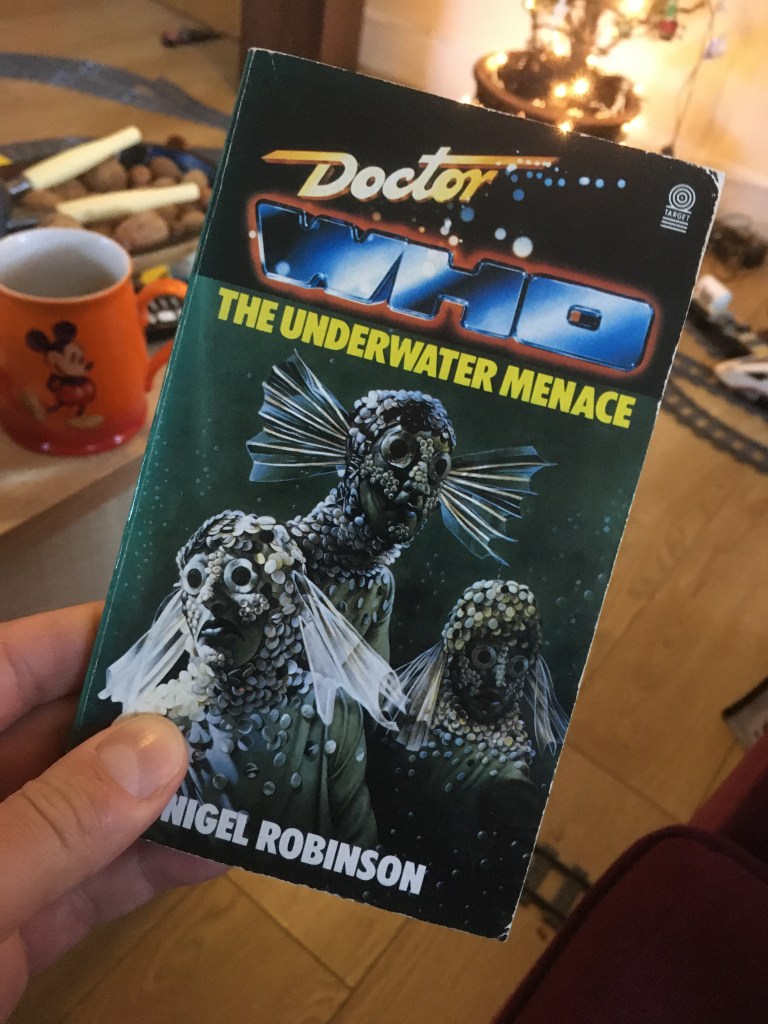
The Underwater Menace – one of a batch of Target novelisations I was bought for Christmas last year – was not one of these, because The Underwater Menace was a Doctor Who book owned by my school library. The only Doctor Who book owned by my school library. So although it might not have been my first Doctor Who book, it was one of the first Doctor Who books I read in the comfort of my own home (the first or second, in fact; the other was Doctor Who In An Exciting Adventure With The Daleks, the grey hardback of which my local library held – oh, those line drawings! The description of the endless TARDIS corridors! The glass Dalek!).

It must, however, have been after that life-changing experience of Doctor Who on television, because I remember this: when I read The Underwater Menace, I attempted to read it as a story featuring the Seventh Doctor and Ace. Quite how long I managed to keep this up for I don’t know; I think it might have been quite stressful, not so much imagining Sylvester McCoy’s Doctor in place of Patrick Troughton’s (not the hugest leap) but somehow turning 60s dolly bird Polly, who in this story is particularly (and uncharacteristically) pathetic, into baseball bat-wielding Ace.

Polly was the only candidate for this treatment: Ben made so little impact I had forgotten he was even in this story until I eventually saw in on video (and even then, he rather fades into the background, possibly because half of his lines have been hastily given to Frazer Hines). And there was no way I’d have tried to turn companion Jamie into Ace, because I was VERY happy to add Jamie to the Seventh Doctor’s crew.

I don’t know why Jamie made such an impact (and having reread this tome, I remain a little baffled). But he did. My pictures of the Seventh Doctor and Ace were immediately and anachronistically joined by the character of Jamie, my ideal TARDIS crew. Which was especially interesting because I had no idea what he had looked like on television. It didn’t matter: I could imagine, and The Underwater Menace put a clear idea of his appearance in my head.

He was a white-haired old man with a fluffy moustache in a kilt and a tam o’shanter.

On picking up this book after all these years, I was curious to see what could possibly account for this – was it possible that Nigel Robinson could be blamed for such a misconception? Well… yes and no. Certainly Jamie’s wide-eyed 18thcentury bewilderment, usually expressed in a colourful vernacular, has more than a little Private Frazer about it. I probably gave him a fluffy moustache because, even though in real life absolutely none of the old men I knew had a fluffy moustaches, in my imagination old men without exception had a fluffy moustache. I blame children’s television.

What I had failed to take note of was a single adjective in the book’s second sentence: ‘It was the only explanation the young Scottish piper could think of’. I picked up his nationality without mishap (I pictured him with a kilt, a detail that I’m pretty sure Nigel Robinson never bothers to fill in). I expect his musical ability didn’t pass unnoticed either (I pictured him with a tam o’shanter, the obligatory uniform of anyone who players the bagpipes – again, I blame children’s television). But thanks to my failure to pick up on his third characteristic, Jamie ended up an old man with a fluffy moustache, and by the time Robinson next mentioned his age the damage was presumably done, picturing-things-in-my-head-wise. This was an adventure featuring the Seventh Doctor, Ace, and an old man with a fluffy white moustache wearing a kilt and a tam o’shanter.

A jolly good adventure I thought it was, too. My subsequent drawings of my portmanteau TARDIS crew attest to that. Reading the book now, its appeal is obvious: it rattles along, Nigel Robinson sticking very much to the Terrance Dicks formula for Target novelisations, and there’s plenty of jeopardy along the way. In fact, it is rather more convincing as a book than it is on television, the idea of the underwater society with its ancient religion continuing uneasily alongside new technology pretty compellingly sold, and the sillier details (‘we turn people into fish so that they can bring us plankton!’) sensibly skirted over. Unfortunately, Robinson can’t skirt over the central plot point that the villain is a man who wants to blow up the world JUST BECAUSE. In a way it’s a pity he doesn’t resign himself more fully and have some fun with this; he’s knowing enough to use the quote ‘Nothing In The World Can Stop Me Now!’ as a chapter title, but I can’t help feeling that a more offbeat narrative approach, like those in the three sublime novelisations Donald Cotton wrote around the same time, would have sold this B-movie stuff rather more effectively.

Not that it bothered me at the time – it is only with adulthood that we fans decide that things like character motivation and scientific plausibility have some part to play in adventures as well as high jinks and derring-do – and even in the absence of those, there is something very modern about the template for this story. The Doctor, an agent of chaos, enters a situation and within 24 hours sparks a rebellion and overturns a regime. Take away the madman trying to blow up the world and you’ve basically got a Cartmel-era archetype right there. Actually, replace the madman with Kate O’Mara and I think we might have found a doppelganger.

So perhaps it wasn’t so inappropriate to try to squeeze the Seventh Doctor and Ace into this scenario after all. The perfect team to take on this kind of fodder, with the aid, lest we forget, of at least one young fan’s favourite moustachioed octogenarian Scotsman, Jamie.

James is occasionally writing reviews of Doctor Who related books on Goodreads, at a rate which should see him get about a quarter of the way through before the inevitable heat death of the universe.

Attack of the Clones

Here’s a problem which came to a head when I spent half of last night’s (very enjoyable) episode of Doctor Who thinking that Keeley Hawes’ character was the same as the recurring ‘Missy’ we have been introduced to, who is actually played by Michelle Gomez, a completely different person.

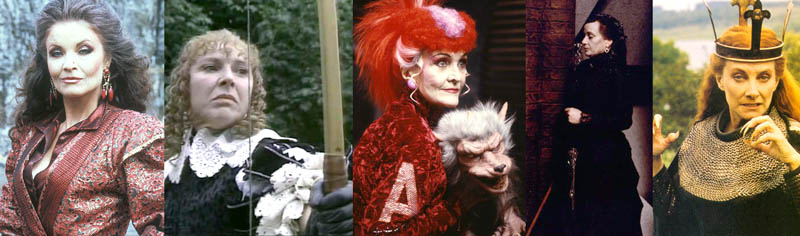
A silly mistake? I know Doctor Who isn’t mine any more, but it’s fair to say I still take more than a casual interest, so I refuse to believe I was the only person who had this problem. Okay, I was tired, and it has been a few weeks since we saw Missy – but I don’t merely put my confusion down to the fact that they have been given a sort of similar physical resemblance (power-dressed in black, power hairstyles piled and pinned, power make-up heavily applied, power cheekbones – go on, I dare you to deny that they’re more than passingly similar…).

DrWhoVillains1

No, what cemented my confusion was the fact that they have both been written with the same character. You know the one: everso sophisticated, polite yet snarky restraint, schoolmarmish and very emancipated. In fact, in describing this villainess-by-numbers, I realise that we’ve seen it in previous episodes of Doctor Who: I’m thinking of Miss Foster, Miss Kislet and Madame Kovarian.

DrWhoVillains2small

It is becoming pretty obvious what kind of woman Doctor Who writers are terrified by.

All of them fine actresses delivering fine performances, by the way – just delivering fine performances of the same character. The only substantial female villain in recent years who doesn’t fit the template is Diana Rigg’s magnificent Mrs Gillyflower, but that episode, The Crimson Horror, was atypical in virtually every way, a darkly comic Victorian runaround that had as much in common with The League of Gentleman (hardly coincidentally, also Mark Gatiss’ finest script for the show). Rigg’s tour de force breathed life into a caricature that might have been played by Gatiss himself in a different context: surely Doctor Who doesn’t need to be doing madcap steampunk absurdism to earn an interesting villainess?

dianarigg1_2553583b

There isn’t the slightest possibility that the rich tapestry of male villains on Doctor Who could ever be confused. But for whatever reason, the series seems to be stuck with a very singular approach to women. Maybe it’s Freudian.

Why aren’t the female writers doing a better job writing female villains, you ask? Ha. Only one woman has written for the series since its return. One. Count ’em. (Count ‘er, I mean.) One. She was already working on Who as a script editor, so she already had a way in for her two stories. It may be irrelevant, but they were both stinkers anyway.

For a really good episode of Doctor Who written by a woman, you need to go back to the supposed last gasps of the ‘classic’ series. You’ll discover that the final story before cancellation was written by Rona Munro (whose trilogy of historical plays just finished a run at the National Theatre, no less). You’ll also discover that she anticipated the Russell T Davies’ council estatey social realism by 14 years, laced her episodes with heavily submerged sexual metaphor and managed to slip the word ‘tosser’ in before the watershed. (Oh, she also wrote beautifully for Sylvester McCoy’s Doctor, reinvented a classic villain, understood the potential for the series to bridge two worlds and got the balance of exciting and frightening just right – in case you’re in any doubt that it’s a really good story.)

That’s the kind of brilliant female writing talent the production team should be actively seeking – specifically female, because a) the series plays an aspirational role in the lives of young boys and girls, and b) because it is clearly lacking a dimension which female writers would undoubtedly bring with them. Before we have another silly debate about whether the next Doctor should be played by a woman, there are far more pressing gender issues the programme needs to address.

Oh, and late 80s Doctor Who, on just four stories a season, had brilliant female villains.

DrWhoVillains3

Nine reasons to be cheerful about Doctor Who

It seems inconceivable that there would be, but just in case there’s any doubt: the series of Doctor Who that ended at the weekend was wonderful and a huge improvement on everything Russell T. Davies did with the show. We can remain distantly grateful that Russell brought the series back but everyone ought to breathe a long sigh of relief that he has been replaced by the far more talented Steven Moffat.

Most people can stop reading there, but if you’re still in any doubt as to what has improved, here’s what:

1. Matt Smith

After all of David Tennant’s gurning and shouting (the greatest achievement of which was to give me a fresh appreciation of the subtlety of Sylvester McCoy’s Doctor), I was willing to be pretty forgiving of any casting decision, but I was more than a little doubtful when they cast somebody who is actually younger than me. A 26-year-old actor playing the Doctor? Really? Isn’t that just pandering to the children and/or the housewives? Isn’t it time for another older Doctor with the gravitas of Hartnell or Baker (Tom)?

I needn’t have worried. Matt Smith is a revelation – he can go from funny to serious in the blink of an eye, he has an energy that is infectious but not irritating, and unlike either of his two predecessors he can do charmingly bonkers without overacting. As for his age, Smith is playing a Doctor far older than he looks, and is actually far more convincingly 900 years old than many of the older actors who came before him.

2. The writing

It has been said by some people that no single episode in the series stood out as a masterpiece in the way that previous Moffat-scripted outings did – that there was no Blink or The Empty Child. I prefer to see it the other way round: unlike previous series, there wasn’t a single episode that made me hurl things at the television. The quality of the writing has rocketed, purely because the focus is much more on storytelling and far less about lengthy goodbyes or saying how amazing space is the whole time. At last, after five seasons of bad plotting, nearly all of the stories had a middle to go with their beginning and end, with plenty of sparkling dialogue, clever twists and compelling concepts along the way. There were a couple of weak episodes, true, but no monstrosities to rival David Tennant’s last dismal outings as the Doctor, or the-one-where-they-tried-to-do-The-Exorcist-meets-the-Olympic-games, or the-one-where-they-were-in-Cardiff-and-nothing-happened.

3. The other regulars

The subtlety with which the character of Amy Pond was crafted to compliment the Doctor, the series arc and the style of the show highlights just how two-dimensional Russell T. Davies’ companions were. Those could be summed up in one or two words (chav, ethnic minority, shouty comedienne); Amy Pond is far more fully-rounded than that, and instead of relying on any working-class-girl clichés the production team have made her a genuine individual. She’s witty, resourceful, vulnerable, flawed, different. And she has a really sexy accent that doesn’t require her to drop her Ts.

She also has none of the baggage that Russell T. Davies was convinced companions needed for us to empathise with them – gone are the frequent visits to mothers, fathers, peripheral boyfriend characters and kitchen. And when a boyfriend character eventually became involved, he was much more than an appendage, being himself a fully rounded person who is both comic and pathetic but also tragic and brave. And both as beautifully acted as they could have been.

On top of which, we’ve revisited the character of River Song, who is absolutely wonderful and, crucially, genuinely mysterious. This is a character whose encounters with the Doctor are happening in reverse order to his with hers (itself a stroke of genius because of the changes of dynamic each time they bump into each other). Moreover, she’s clearly dangerous, has unpleasant secrets and may or may not be married to the Doctor. The whole character gets more mindblowing every time she turns up, in exactly the way that Captain Jack didn’t. Russell T. Davies gave us a bisexual man from the future played by John Barrowman; Steven Moffat gave us an enigmatic time traveller from the Doctor’s future played by Alex Kingston – draw your own conclusions.

4. It’s not a children’s programme any more

…and at its best, Doctor Who never was. At last, we’ve moved away from patronising cultural references and fart jokes and Doctor Who is properly smart, witty and frightening. In other words, adult. The kids will of course continue to love it, because it’s smart, witty and frightening, but nothing about this series said ‘children’s television’ – the stories were complex, the themes were challenging and there was a darkness that makes the series genuinely unsettling in exactly the way it needs to be if it’s to have pre-teens scuttling behind the sofa. The ruthlessness with which Rory was erased from history, then reappeared but turned out not to be Rory at all! shows that we really don’t know what to expect from this production team and they will horrify us and break our hearts as any good drama series ought to.

5. The Doctor is genuinely alien

Russell T. Davies’ Doctor was invariably one of the gang – the popular kid in school, quite often rubbing other people’s faces in it and (at his worst) bragging about who he’d been shagging. To make him simultaneously an ‘outsider’ (because he’s an alien, after all) scripts were forced to shoehorn in a whole load of boring angst (he’s bouncy and fun but so lonely underneath!).

All that has changed. The new Doctor is genuinely ‘different’ – his behaviour, his actions, his attitudes all showing him to be from a different world. He’s still successful and sometimes popular, but it’s not what drives him – in fact, the childlike glee with which he discovers people like him or that he’s good at football is much more that of the quirky kid in school who doesn’t quite fit in but gains respect for being an individual. Exactly the sort of role model he ought to be (especially as this Doctor speaks the Queen’s English properly for once).

6. The Doctor isn’t fetishised

Russell T. Davies clearly felt the Doctor ought to be a sex symbol, with each of his companions (and sometimes their mothers) having a tedious crush on him even though the implications of teenage girls being in love with a 900-year-old man are actually a bit unpleasant. This policy reached its nadir when Russell T. Davies had the Doctor cloned so that Billy Piper could have him as a fuck-buddy.

So thank goodness that for all of his youthful floppy-haired appeal, we now have a Doctor who stands apart from all of that; when Amy Pond did try it on with him it was clear how much had changed – rather than going all Peter Stringfellow, he set out to repair her relationship with her fiancé. It’s not that he’s asexual, it’s that something more interesting than adolescent infatuation is the thing holding the TARDIS crew together.

7. The special effects

It’s not that they’re better. But when the old production team spent money on a shot it was like they wanted you to study it until you knew exactly how many thousands of pounds it was worth. The correct approach to special effects is to hide them, pretend they’re the same as all the other shots, so that they tell the story and don’t draw attention to the inevitable shortcomings of a BBC budget. As such, the series has achieved a far more expensive look, which is ironic because money has certainly been slashed from the budget in line with the spending plans of the rest of the country.

8. The season finale

Yes, everything was solved by magic in the end and it didn’t really make sense, but who cares when it was done so stylishly? For the first time since it was brought back, a Doctor Who finale actually exceeded expectations and absolutely made an asset of the series arc. From its opening, which elegantly revisited locations from previous stories and beautifully wove an even more complex picture than that which had already been built up, to the conclusion, which trod back through the series and started where everything began, revealing precisely how cleverly the whole story had been laid out from the start, this was as satisfying a resolution as we could have hoped for.

9. The future

Russell T. Davies’ best series, overall, was his first. That had the feel of a series where everyone was trying hard to make it the best it could possibly be, to explore the range of the concept in every single episode. The subsequent drop in quality (pretty much consistent from one series to the next) was absolutely the result of complacency. Lazy writing and self-indulgence became habitual.

Why do I think this won’t be the case under Moffat? Primarily because of Moffat’s own writing. Even though it can be argued that some of his later scripts are not his finest work, it’s very clear that he’s not standing still. Where they fail it’s because he’s doing something different. Where they succeed they show a writer who wants to do something better each time he puts pen to paper. Even Doctor Who Confidential has lost its smug, self-congratulatory air. So what we’re going to get next year will, I predict, be even better than what we’ve had so far.

Lest you’re worried that I’m being so uncharacteristically positive about everything from the coalition government to Doctor Who that I must have been replaced by an Auton replica: of course there have been things that pissed me off. There’s still a tendency for the Doctor to run around stroking his sonic screwdriver like BBC marketing are breathing down his neck (it’s just a screwdriver…) and there was that daft Richard Curtis episode in which nothing happened. But it’s churlish to complain when so much has improved and when it looks set to get even better. As far as I’m concerned, there’s only one thing in need of urgent attention, which has been a constant problem episode after episode:

1. The music

It’s awful. Not just the new theme arrangement (though that is the sonic equivalent of a motorway pile-up) but every single time the incidental music pipes up it’s wrong. It’s often that sub-Stravinsky relentless thump that blares away even when people are trying to talk and which for Pavlovian reasons now conjures up a mental image of a little cartoon Graham Norton swinging his hips. But it’s just as likely to be a sickly sweet melody telling us quite how emotional we ought to be getting when something – erm – emotional is happening. Murray Gold is about as heavy handed as a composer can get, wallpapering the show with the most literal music interpretation of what is on screen (ooh, it’s a country scene, I’ll writing something cheerful and pastoral! …or how about you just shut up for once?) and now that the series has achieved a new level of subtlety it feels even more inappropriate than it did before.

A programme as music-heavy as Doctor Who is clearly not being served by a single man having to score the whole lot, so why Murray Gold has ended up doing it all is a mystery (unless he’s giving them a special discount – buy music for one episode and I’ll recycle it for a further two episodes free?). It’s absurd to rely on the efforts of a single hack when there are loads of composers highly capable of delivering superb television scores.

And yes, the fact that I’m one of them makes it rankle even more.

I was bullied by people like him…

Naturally, when I watched this year’s annual Christmas disappointment – i.e. Doctor Who – the things that bothered me were variations of the usual questions, like: does anybody find these topical references to the economic downturn anything other than utterly embarrassing? Did nobody edit this script before the actors started learning these long, long scenes of dull exposition? Did Russell T. Davies really think that multiple John Simms wearing dresses was the doom-laden cliffhanger image befitting the penultimate episode of David Tennant’s Doctor? Doesn’t Bernard Cribbins deserve better? Doesn’t Timothy Dalton deserve better? And, generally, why oh why oh why oh why…?

But I was already resigned to the whole two-parter being the uncomfortable enema that the series so badly needs, and everything this year has led me to prepare myself for such questions. The question that I wasn’t expecting almost slipped me by at the time of broadcast but is now possibly the most concerning thing about the whole episode, and it is this:

He said what about Good Queen Bess?

So unlikely it seemed, I thought I must have imagined it – so I went and checked it out. And I hadn’t imagined it.

What David Tennant’s Doctor says is this (in his most irritating mockney): “Got married! That was a mistake. Good Queen Bess. And let me tell you, her nickname is no longer…” (does his most irritating mockney oops-missus-I’ve-been-naughty face).

Unless I’m totally misinterpreting Russell T. Davies here, what he wrote for the Doctor to say was the pre-watershed equivalent of “then I shagged Queen Elizabeth”. And whilst I think I am accurately imagining Russell T. Davies chuckling to himself as he knocked the line out, a little chunk of my childhood died when its meaning really dawned on me.

The Doctor has never been interested in sex. When Paul McGann kissed his companion in 1996 a lot of fans kicked up a fuss, though in actual fact it all turned out to be all rather innocent. The new incarnation of the series has had various female companions boringly fall in love with the Doctor and he has formed some strong attachments to them, though this isn’t necessarily a problem as love is a noble thing.

But by making the Doctor a person who casually refers to the notches on his bedpost (whether he did it within wedlock is hardly the point), he has become something that the Doctor has never been before – someone I despise. Tennant’s Doctor was already headed in this direction: he’s vain, a show-off, effortfully trendy – the cool kid in the playground rather than the outsider the Doctor ought to be. But now he is the kid who brags about how many girls he has casually felt up behind the bike shed, which is either misogynous or simply shows a lack of respect for other people (the brush, incidentally, which tarred all gay people in T. Davies’ Queer as Folk). The most sinister thing is that Russell T. Davies, who clearly finds nothing at all objectionable about such bragging, has snuck this character up on us bit by bit, delivering the final blow as a casual one-liner that actually exacerbates the nastiness when you analyse it.

It goes further than a loss of innocence; it makes the Doctor, who has always stood for moral values, respect and equality, a terrible role model for the very people who adore him. I’ve been told by various people that they think David Tennant is the best Doctor ever; sorry folks, but I simply can’t wait to see the back of him.

(That police box takes him everywhere!)

I’ve just finished wading my way through the shiny new DVD release of The Trial of a Time Lord and I have to say it’s been the best Christmas money spent for quite some time.

Not for the story so much, which is as patchy as ever for all its delights, but for the extra features. This is where the real behind-the-sofa stuff is hidden – as if the story of all the back-stabbing and bureaucratic blame-shifting that went on in the Doctor Who offices in the 1980s wasn’t scary enough, the monsters here are truly convincing and utterly terrifying. Clips of militant Liverpudlian Doctor Who fans menacing writers Pip and Jane Baker (who are pretty scary-looking themselves) compete unsuccessfully for terror-factor against Ian “bubbling lump of hate” Levine, a fan who really got too big for his boots (in more ways than one). It’s hard enough to see why he’s on the DVD at all, even less so how he managed to enveigle his way into the Doctor Who production office sufficiently to be able to launch a significantly damaging attack against the producer.

And let us not forget, presented on the DVD in full, the most terrifying thing Doctor Who has ever spawned, bar none!!!:

…the words are in fact the work of the great Ian Levine, and indeed it’s hard to deny that “there was the Brigadier and the Master and a canine computer” or that “each screaming girl just hoped that a Yeti wouldn’t shoot her”. It’s all the more poetic for being accurate, the spelling of “canine” aside.

Best of all, though, the DVD contains the following moment from Saturday Superstore:

23 today

Let’s just analyse what’s going on here: Colin Baker is cutting a cake in the shape of a TARDIS, watched by presenters Sarah Greene, Mike Reid and John Craven, four Time Lords, a creature which is possibly a Mandrel crossbred with a Mentor, Ludo from seminal but non-Doctor Who-related film Labyrinth, two kids wearing party hats and, holding one of them on his lap, a man who may or may not be Bono.

That was the 1980s, that was.

The man who comes out of the DVD with the most dignity, by the way, is Colin Baker, clearly shown here to be both a nice man and a super Doctor who just happened to be doing his job at the worst possible time. Whatever Ian “bubbling lump of rhyming 80s fanwank shite” Levine manages to imply, the material on the DVD makes it more than clear that there was more than one fine Baker to take on the Doctor’s mantle. How ironic that one of the contributors suggests that his performance is too big for television – has he seen David Tennant???