
What I'm doing right now
Having had a successful improjam earlier, I’m in full Uncertainty Division mode, and am trying to tidy up the website a little. So far I have:
- Doodled something to do with company information
- Found a photo of Andrew P that I quite like
- Got the web pages to validate
This is not, when it comes down to it, terribly productive. And I really should be doing some writing. Hmm.
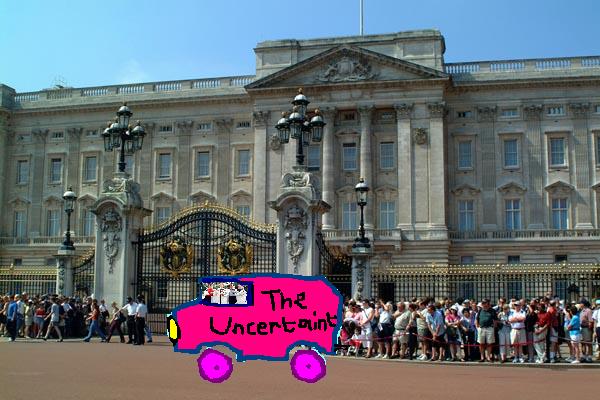
What the other side of the Uncertainty Division minibus will look like

Proposed design for Uncertainty Division minibus

Disposables
I have just come across a company called Helapet. Helapet is a leading supplier of disposables to the UK Hospital market. But it occurs to me that it is also the way that Anthony Windram would pronounce “Heliport”.
A little busy …
Busy writing an awful lot of dull things I won’t bore you with (much use of restraint to avoid describing competitors as “febrile”). And nursing a sore shoulder, which either came about due to holding a camera on my shoulder on Sunday or – less likely – due to my lovely new scarf, which I maybe tied a little too enthusiastically round my neck this morning.
It really is very lovely. Cashmere, and everything.
Words we don't hear enough of
Today, words beginning with the letter ‘F’. Try to get them into conversation. Try to get them into a Valentine’s message. Here they are:
Fey
This is a fantastic word, because it means so many things. Doomed, according to the Scots. To clean out, if you believe Tusser (whoever he is). Slightly mad, which is of course one of the best meanings. Suggestive of an elf, which is certainly how I’ve always taken it (with an undertone of effete). And finally, Chaucer thought it meant faith – but then he was, well, fey.
Funicular
Related to a cord or cable – most useful as in “I say, is that a funicular railway adorning the horizon? What larks!”, which can only really be carried off by a young bounder in Austria. Who is probably a bit fey.
Febrile
Feverish. I also use it to mean childish, in a slightly metaphorical, slightly wrong, fashion.
Happing effing!
Nice
The biscuits currently sitting in the biscuit box at the office in which I occasionally work are those rectangular sugary ones labelled “Nice”.
Although not my favourite type of biscuit, they really are extremely nice. I had eaten several today when I suddenly stopped and thought, “Why bother to label the biscuits “Nice” when it’s patently obvious to anybody eating them that they are nice?”
For a while I wondered if this was the equivalent of signing for the deaf in orchestral concerts, a description of the biscuit for people unfortunate enough to lack the ability to taste.
Then a more sinister thought occurred to me. Do the makers of this particular brand of biscuit hope that, with the subliminal suggestion that the biscuit will be nice imprinted on the eater’s brain prior to eating, the eater will naturally assume that it is nice without actually bothering to taste it?
Well, thought I. They will not entrap me with any such psychological ploy.
Then I realised that I do think the biscuits are nice. I was munching my way through my seventh for precisely that reason. Alarmed, I wondered if my mind had been twisted by the subliminal suggestions of the innocent-looking writing on the front of the biscuit. Of course, there was the possibility that the biscuits are actually nice, and my taste buds had not been fooled at all. But how to be sure?
I decided to set up an experiment; I prepared three biscuits, one with the word “Nice” on the front as usual, the basic biscuit under scrutiny. Secondly, I took a biscuit of the same brand but scratched the word “Nice” off with a paper clip, to see if that made a difference to the taste. Thirdly, as a control, I had not a biscuit at all but just air.
The air tasted of just air. The unaltered “Nice” biscuit tasted nice. The biscuit with the word “Nice” scratched off it also tasted nice.
What am I to conclude? Have I been exposed to the “Nice” biscuits for too many years to be able to resist the suggestion of the word “Nice” even when it is concealed? Is the taste of the biscuit alone now enough to fool me into enjoying it?
It is a frightening thought that biscuit companies hold such power over consumers.
AdWatch
Noticed two adverts on the tube this morning. The first is by Refuge, showing a group of twenty-somethings at a dinner party, all laughing away merrily and not looking while one of the men smacks his partner to the floor. The caption is something like “Domestic violence: don’t look away”. Pretty powerful, I think.
Adverts that tell you something, not sell you something, tend to be more worth looking at, in my opinion. There was an online advert for Customs & Excise when they were cracking down on illegal cigarette importing – one of our designers created half a dozen fake “get your ciggies from Spain” websites (which were truly vile, and indistinguishable from the real thing), and when you clicked on an offer, a big menacing face popped out and told you off for being naughty. Although I’ll admit most of the enjoyment we got was in figuring out how utterly naff the designs needed to be to be convincing.
The other advert I noticed this morning was for the last series of Friends. It’s frankly awful – actually a series of adverts, each with a large picture of something associated with the series (a pair of reclining chairs, a duck and a chicken, a crowd of people asleep) and some slogan I forgot pretty much immediately. Although I’m not really the target market, so who cares? And it’s certainly better than showing photos of the cast.
I’m wondering if perhaps informational adverts are just easier to make well than ones that sell – selling things gets caught up with psychology, while conveying information is something people have done for thousands of years. Or maybe it’s just that Refuge have more money than … Channel 4?
Titular fancy
What I was thinking was, there’s never been a play written about indecent assault in a Post Office. It could be called “You are being held in a queue”.
 Talk To Rex