Doctor Who: the top ten special features

Doctor Who fans like making lists, and as the 60th anniversary approaches the internet has been inescapably swamped with top tens (or, for the thematically astute, top 60s) of best stories. You know the form: Androzani, Talons, Human Nature/Family of Blood, too many lists featuring The Dalek Invasion of Earth and not enough featuring The Myth Makers.1

I love a good list as much as the next man, but rather than add to the noise and use up more precious, dwindling internet space with a list that will only upset people because of the inclusion of Delta and the Bannermen, let me offer up a top ten of something else that deserves plenty of attention.

Us fans are absolutely spoiled when it comes to home media. Doctor Who on DVD and Blu-ray gets the kind of attention that is generally reserved for cinematic masterpieces, particularly when it comes to what is now troublingly called ‘the classic series’, which has been painstakingly restored a story at a time with a quality and attention to detail that can only be a labour of love by the Doctor Who Restoration Team (I can’t believe anyone involved is getting paid for more than a fraction the hours or expertise they put in). Archive sources have been scoured for the best quality versions, episodes with colour missing have had colour put back into them, missing episodes have been reconstructed or animated, and the whole lot has been released with an abundance of extra features – archive material, related programmes, documentaries new and old, optional surround sound mixes2, optional new special effects3, special editions4, all of which not only maintain the high standard set by some of the very earliest DVD releases but consistently aim to eclipse what has come before.
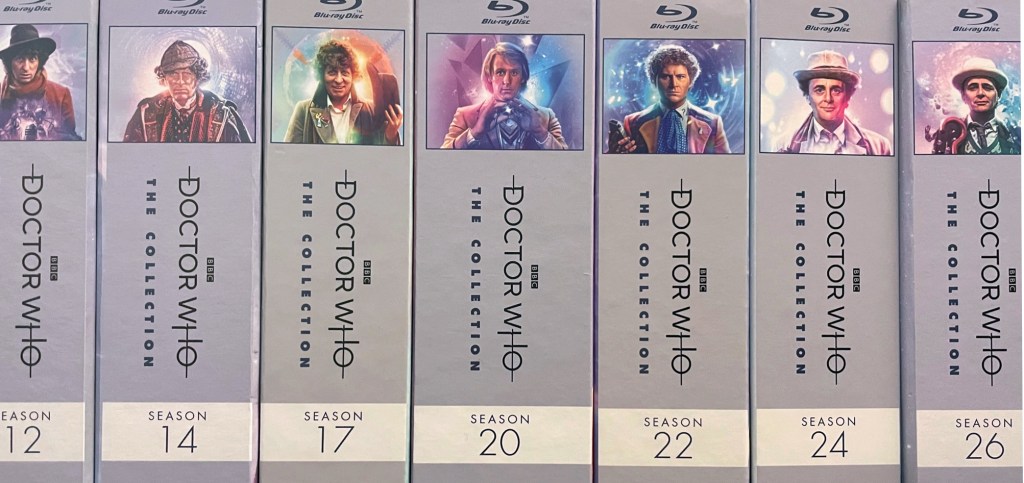
Several volumes of Doctor Who The Collection on Blu-ray, displayed as God intended them without those cardboard sleeves they arrive in.

It’s all too easy to take for granted, but you only have to look at the considerably less special features included with most television Blu-ray releases (and indeed many expensive ‘special editions’ of big budget movies) to see how lucky we are. The gorgeously-packaged and lovingly curated The Collection Blu-rays continue to allow us to view stories we have seen countless times in a new light, and (glances around guiltily) I’d even go so far as to say that some of the extra features are more entertaining than the stories they accompany.

So let’s celebrate some of the best ones. The countdown begins next week!

First up: ‘it would have been such a poison chalice because they hated it so much…’

  1. I bloody love The Dalek Invasion of Earth, though that is for reasons more subjective than objective, and the film version is better. None of that is a reason not to put it on a list, but the recent Doctor Who Magazine readers’ poll has it as the best Hartnell, which suggests that either most fans haven’t even bothered to get to know The Massacre, The Gunfighters, The Myth Makers and The Crusade (to name but a few superior stories), or that most fans are blind to shabby direction and mediocre dialogue. Or that they’re not into history. Perhaps all three. ↩︎
  2. The work Mark Ayres does on sound is breathtaking, and creating surround sound mixes of material recorded for television in the 1970s is not only a labour of love but a labour of determined lunatic virtuoso brilliance. ↩︎
  3. To be honest I’m less keen on the option to watch shonky model effects replaced by shonky CGI that doesn’t match the material around it. It’s even less fathomable when the shonky CGI replaces excellent model effects (cf The Invasion of Time, The Invisible Enemy, Enlightenment). I’ll sort of make an exception for Day of the Daleks, where they went to the trouble of using exactly the same camera and location to shoot new material to improve the underwhelming original with brilliant results – but why go to all that trouble to match the material if you’re going to stick some CGI buildings in as well? All of that said, I fully acknowledge that the optional new effects are just that – optional – and that they’re switched off by default. I’m not complaining about them, they’re just not for me. And if they bring some of you joy – well, a lot of you reckon The Dalek Invasion of Earth is the best Hartnell, so I already think you’re a weird bunch. ↩︎
  4. Some of the McCoy special editions are now more or less the definitive versions of those stories, and with good reason. ↩︎
Nae man can tether time nae tide

I don’t remember which came first, Doctor Who on television or Doctor Who in print. I can say with certainty that the weekend when I stayed the night at my best friend Matthew’s house and he showed me Daleks: Invasion Earth 2150AD and parts two to four of Remembrance of the Daleks had a destiny-shattering effect on the rest of my life, propelling me into a future of scrawled cartoon Daleks, obsessive reading and cataloguing of fact and fiction, followed by a VHS then DVD and now slightly more cautious blu-ray habit. Nothing serious, you understand: just standard fan stuff. It was bound to happen eventually.

But the books follow a slightly different timeline. They held an appeal for the same reason as the Nicholas Fisk books I devoured: evocative titles matched with evocative images. For all the idiomatic urging not to judge books by their covers, when I was growing up I absolutely did. Still do, truth be told. As has every child I have ever taught. Publishers, get your covers right.

There was an entire children’s Waterstones in Bath where my Grandparents lived – an entire shop full of children’s books – and one of its biggest delights was a whole shelf devoted to the colourful Target series, a universe of stories to explore. On each of our many visits I would hover there for what felt like hours dipping into the treasures on display. I read whole stories there. If you bought your Doctor Who books in Bath and found they were often a bit grubby… well, sorry, that might have been me.

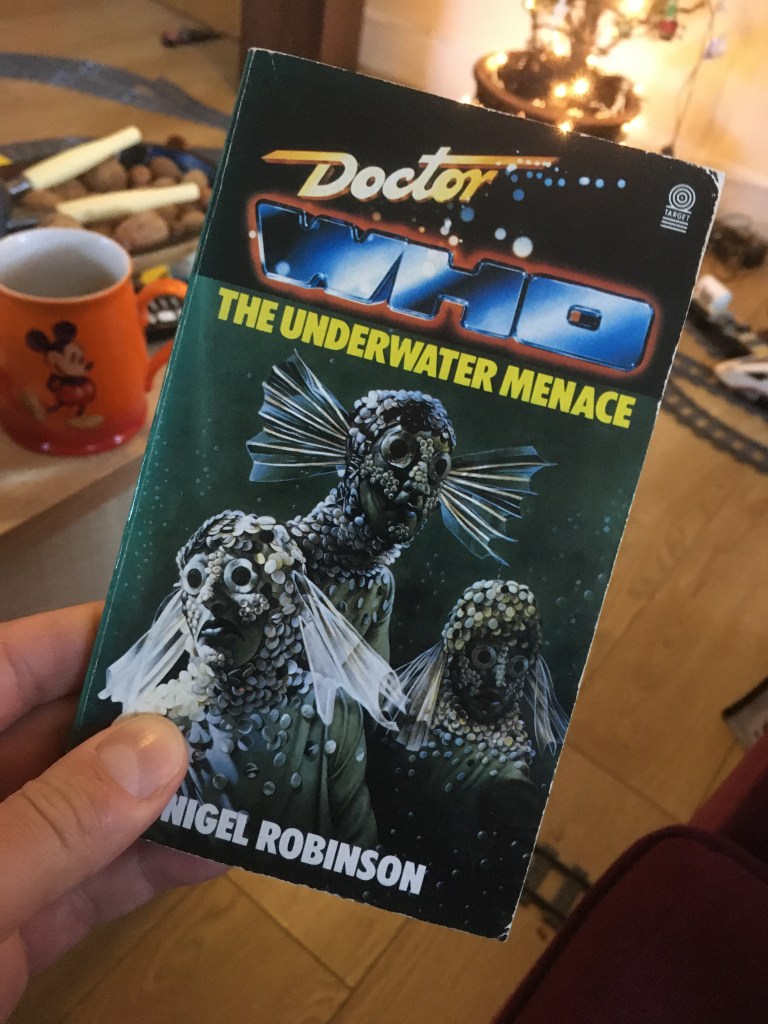
The Underwater Menace – one of a batch of Target novelisations I was bought for Christmas last year – was not one of these, because The Underwater Menace was a Doctor Who book owned by my school library. The only Doctor Who book owned by my school library. So although it might not have been my first Doctor Who book, it was one of the first Doctor Who books I read in the comfort of my own home (the first or second, in fact; the other was Doctor Who In An Exciting Adventure With The Daleks, the grey hardback of which my local library held – oh, those line drawings! The description of the endless TARDIS corridors! The glass Dalek!).

It must, however, have been after that life-changing experience of Doctor Who on television, because I remember this: when I read The Underwater Menace, I attempted to read it as a story featuring the Seventh Doctor and Ace. Quite how long I managed to keep this up for I don’t know; I think it might have been quite stressful, not so much imagining Sylvester McCoy’s Doctor in place of Patrick Troughton’s (not the hugest leap) but somehow turning 60s dolly bird Polly, who in this story is particularly (and uncharacteristically) pathetic, into baseball bat-wielding Ace.

Polly was the only candidate for this treatment: Ben made so little impact I had forgotten he was even in this story until I eventually saw in on video (and even then, he rather fades into the background, possibly because half of his lines have been hastily given to Frazer Hines). And there was no way I’d have tried to turn companion Jamie into Ace, because I was VERY happy to add Jamie to the Seventh Doctor’s crew.

I don’t know why Jamie made such an impact (and having reread this tome, I remain a little baffled). But he did. My pictures of the Seventh Doctor and Ace were immediately and anachronistically joined by the character of Jamie, my ideal TARDIS crew. Which was especially interesting because I had no idea what he had looked like on television. It didn’t matter: I could imagine, and The Underwater Menace put a clear idea of his appearance in my head.

He was a white-haired old man with a fluffy moustache in a kilt and a tam o’shanter.

On picking up this book after all these years, I was curious to see what could possibly account for this – was it possible that Nigel Robinson could be blamed for such a misconception? Well… yes and no. Certainly Jamie’s wide-eyed 18thcentury bewilderment, usually expressed in a colourful vernacular, has more than a little Private Frazer about it. I probably gave him a fluffy moustache because, even though in real life absolutely none of the old men I knew had a fluffy moustaches, in my imagination old men without exception had a fluffy moustache. I blame children’s television.

What I had failed to take note of was a single adjective in the book’s second sentence: ‘It was the only explanation the young Scottish piper could think of’. I picked up his nationality without mishap (I pictured him with a kilt, a detail that I’m pretty sure Nigel Robinson never bothers to fill in). I expect his musical ability didn’t pass unnoticed either (I pictured him with a tam o’shanter, the obligatory uniform of anyone who players the bagpipes – again, I blame children’s television). But thanks to my failure to pick up on his third characteristic, Jamie ended up an old man with a fluffy moustache, and by the time Robinson next mentioned his age the damage was presumably done, picturing-things-in-my-head-wise. This was an adventure featuring the Seventh Doctor, Ace, and an old man with a fluffy white moustache wearing a kilt and a tam o’shanter.

A jolly good adventure I thought it was, too. My subsequent drawings of my portmanteau TARDIS crew attest to that. Reading the book now, its appeal is obvious: it rattles along, Nigel Robinson sticking very much to the Terrance Dicks formula for Target novelisations, and there’s plenty of jeopardy along the way. In fact, it is rather more convincing as a book than it is on television, the idea of the underwater society with its ancient religion continuing uneasily alongside new technology pretty compellingly sold, and the sillier details (‘we turn people into fish so that they can bring us plankton!’) sensibly skirted over. Unfortunately, Robinson can’t skirt over the central plot point that the villain is a man who wants to blow up the world JUST BECAUSE. In a way it’s a pity he doesn’t resign himself more fully and have some fun with this; he’s knowing enough to use the quote ‘Nothing In The World Can Stop Me Now!’ as a chapter title, but I can’t help feeling that a more offbeat narrative approach, like those in the three sublime novelisations Donald Cotton wrote around the same time, would have sold this B-movie stuff rather more effectively.

Not that it bothered me at the time – it is only with adulthood that we fans decide that things like character motivation and scientific plausibility have some part to play in adventures as well as high jinks and derring-do – and even in the absence of those, there is something very modern about the template for this story. The Doctor, an agent of chaos, enters a situation and within 24 hours sparks a rebellion and overturns a regime. Take away the madman trying to blow up the world and you’ve basically got a Cartmel-era archetype right there. Actually, replace the madman with Kate O’Mara and I think we might have found a doppelganger.

So perhaps it wasn’t so inappropriate to try to squeeze the Seventh Doctor and Ace into this scenario after all. The perfect team to take on this kind of fodder, with the aid, lest we forget, of at least one young fan’s favourite moustachioed octogenarian Scotsman, Jamie.

James is occasionally writing reviews of Doctor Who related books on Goodreads, at a rate which should see him get about a quarter of the way through before the inevitable heat death of the universe.